Deployment#
Servers#
The application is deployed on a DRAXIS server using Docker. This server, equipped with the DiMAT stack, handles the execution of the necessary components, such as Laravel for backend processing, MySQL for database management, and Grafana for data visualization.
Networking and Communication#
A stable internet connection is essential for accessing the services on the server. While no special network hardware is required, MEC-LCA (which includes Grafana, Laravel, and MySQL) relies on a reliable connection to remain accessible. Users interact with the toolkit through a public URL, so consistent internet access is essential.
Recommended computing resources for solution#
The toolkit runs on Docker, hosting services like Grafana for data visualization, Laravel for backend processing, and MySQL for database management. For standard usage scenarios, a minimum configuration of 2 CPUs, 4 GB of RAM, and 120 GB of storage is suggested. However, if you’re handling higher levels of traffic or more complex data processing, you will need at least 4 CPUs, 8 GB of RAM, and 240 GB of storage.
Deployment PATTERN#
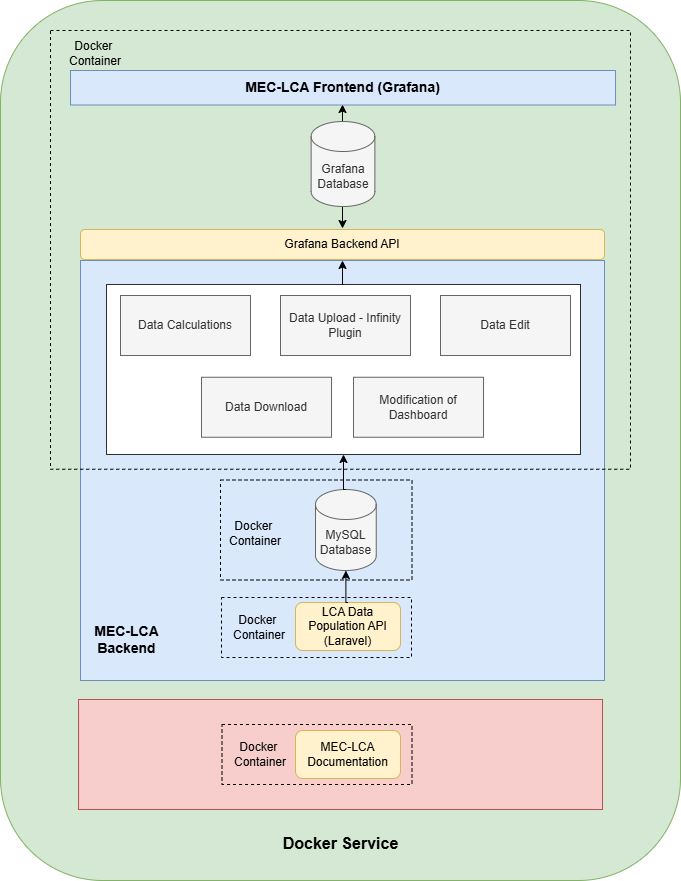
The toolkit is deployed using Docker containers and hosted on a DRAXIS server. It is designed as a standalone installation but can support both monolithic and microservices deployment modes.
In total, it contains three docker containers. The first Docker container hosts the MEC-LCA Frontend, which uses Grafana for data visualization. The data is stored in a Grafana database and can be accessed from both the frontend and backend through the Grafana Backend API. The MySQL database supports these functionalities, and it is populated by an LCA Data Population API built with Laravel, both running in separate containers.